

Over coffee, a friend said, “I don’t see convex problems in industry.”
They are right. Feasible sets are not always connected. Objectives can have many local minima. Some decisions are discrete. Models can contain physics, uncertainty, data, business rules, and constraints that do not fit neatly into a convex template.
So why study convex optimization?
Because convex optimization is one of the cleanest places to learn how optimization works.
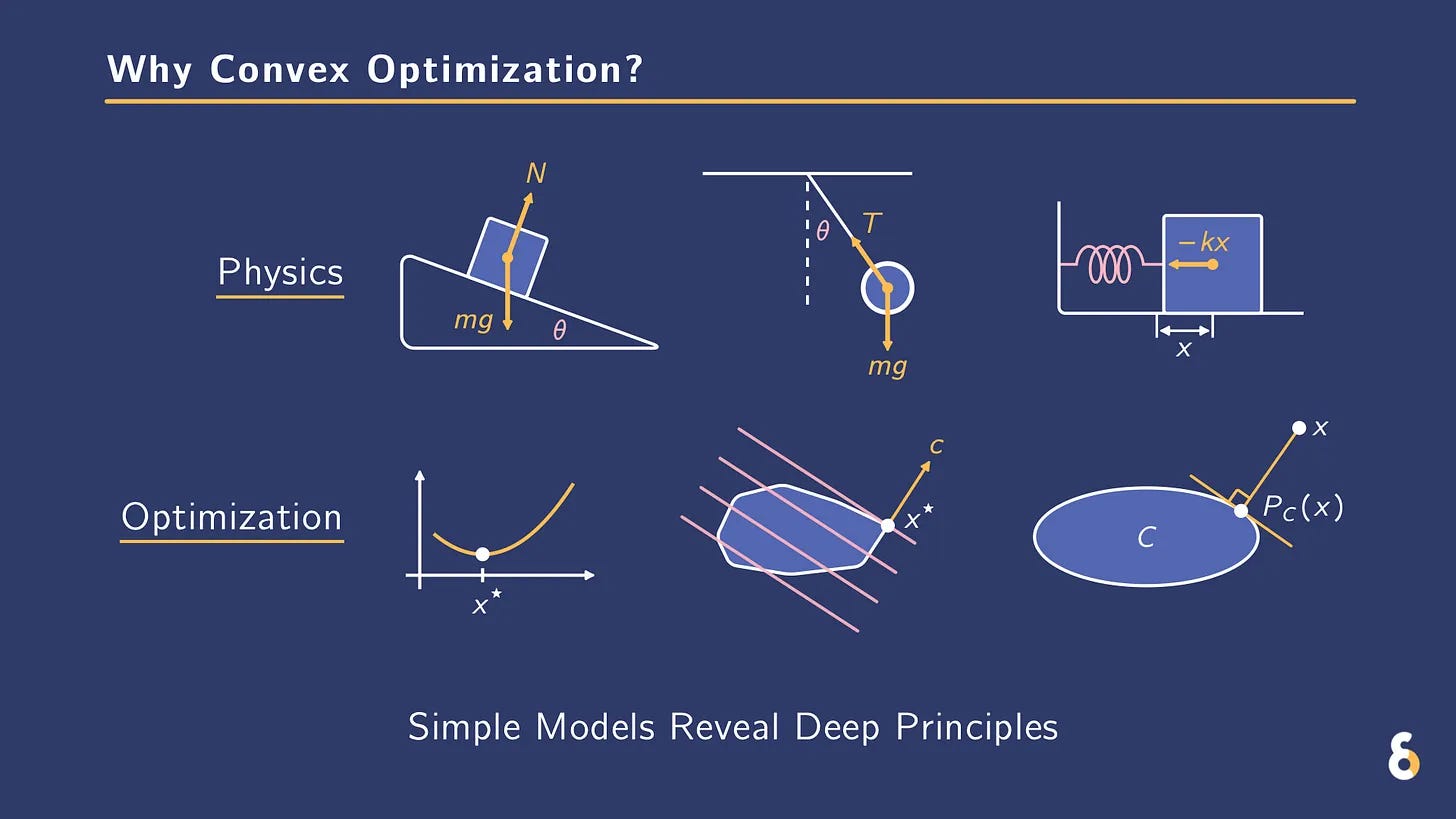
Introductory physics is full of simple models: point masses, frictionless planes, springs, ideal pendulums. We do not study them because the world is literally made of frictionless planes. We study them because they remove enough detail for the main idea to become visible.
A point mass helps us understand motion. A spring helps us understand force and energy. An ideal pendulum gives us a clean picture of oscillation.
Convex optimization plays a similar role. It gives us simple models in which the core ideas of optimization can be well understood.
The Value of the Clean Picture
A convex quadratic is more than a simple diagram (bottom left of figure). It shows a special relationship between local information and the whole problem. At a point on the curve, the slope tells us which directions decrease the objective. If no direction goes downhill, then the point x* is globally optimal.
A linear objective over a polytope gives another picture (bottom middle of figure). As a level line moves across the feasible region, the last point of contact is often a corner or a face. From this simple diagram, we begin to see why extreme points matter in linear programming and why some algorithms search over vertices.
Projection gives another clean picture (bottom right of figure). A point outside a convex set has a nearest point inside the set. This turns feasibility into geometry. Instead of treating constraints only as equations or inequalities, we can ask how far we are from the allowed region and which direction brings us back.
These illustrations are not decorations. They are tools for thought. Geometry suggests what an algorithm should do. They also give intuition for questions that return throughout optimization:
Where should the algorithm move?
What can it know from local information?
How quickly can it reach the answer?
When should it stop?
How can we know it has really found the best point?
When the Problem Is Not Convex
Real problems often are not convex. That does not make the convex case irrelevant; it makes it a reference point. A hard problem may be replaced by a simpler convex one, solved through a sequence of convex subproblems, or compared against a convex bound. In each case, the convex model gives us something to hold onto: a starting point, a benchmark, or a way to understand what the harder problem is asking.
The simplification has to be chosen carefully. If it removes the part of the problem that matters, it may be easy to solve and still miss the point. Convex optimization does not replace modeling judgment. It gives that judgment a clearer language: What structure does the problem have? What information can the algorithm use? What does the answer prove? What did we gain, and what did we lose, by simplifying?
Those questions remain useful even when the final problem is not convex. So, although convex optimization is not the whole of optimization, it is one of the clearest places to learn how to think about it.